
RHS Badminton 2026
A celebration of compost and community
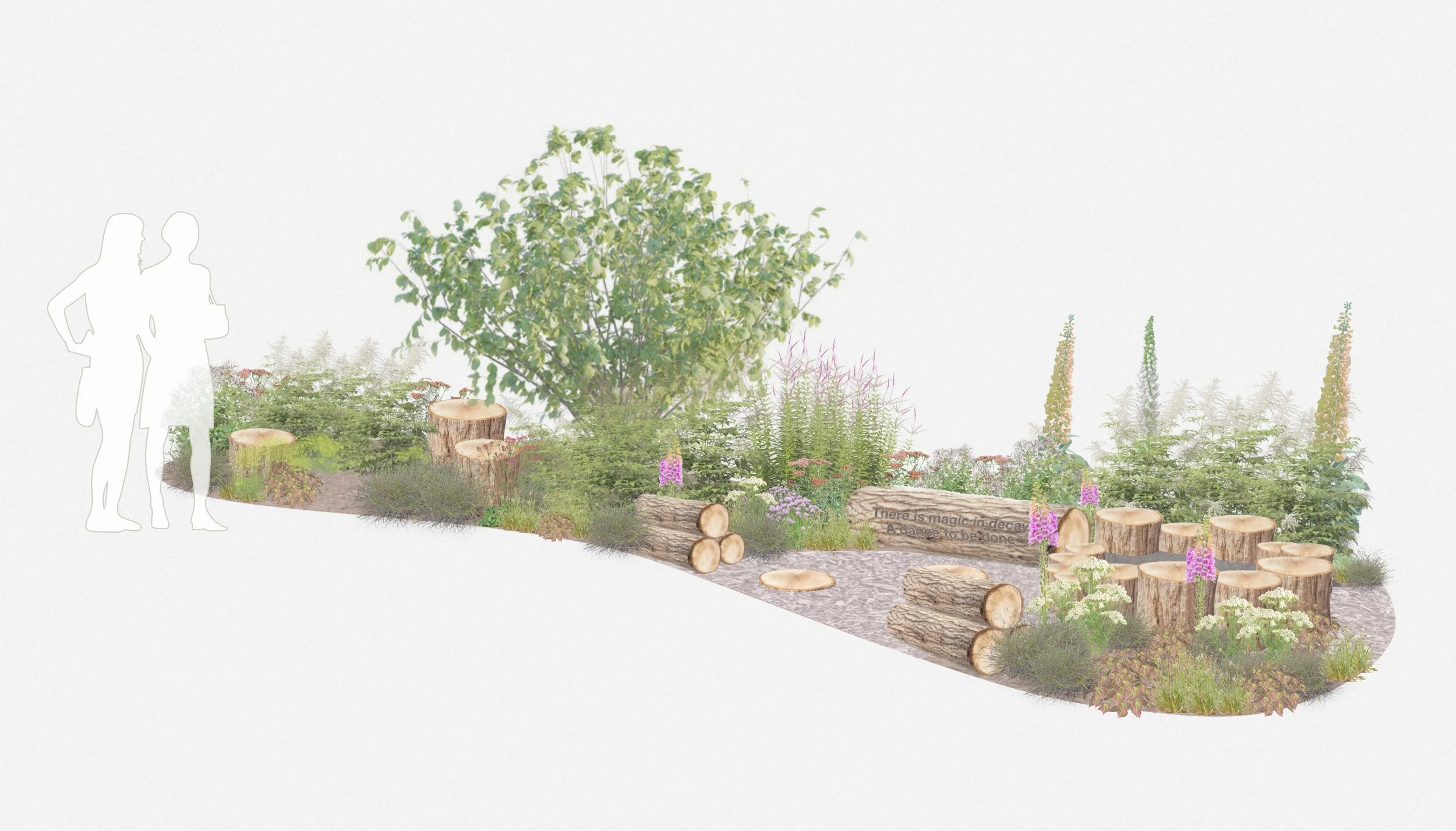
This garden, selected for the RHS Badminton Flower Show 2026, celebrates all elements of compost and community. It is designed to highlight how recycled green waste feeds soil fertility, which creates a thriving ecosystem that helps our plants grow healthy, and it explores the role of decay in creating beautiful, sustainable gardens.
Evoking the continuous cycle of decomposition and regenerative growth on a woodland floor, the garden has a woodland-edge theme full of plants that thrive in fertile soils. Open areas of woodchip contrast with denser planting to represent the green and brown materials required for good compost.
Deadwood structures in the design provide sculptural interest and habitat for detrivores. An enclosed log structure incorporates finished compost. Vertical character plants represent the dynamic shift of emergence, celebrating new life from organic waste. A log laid flat displays a message celebrating the magic of decay.
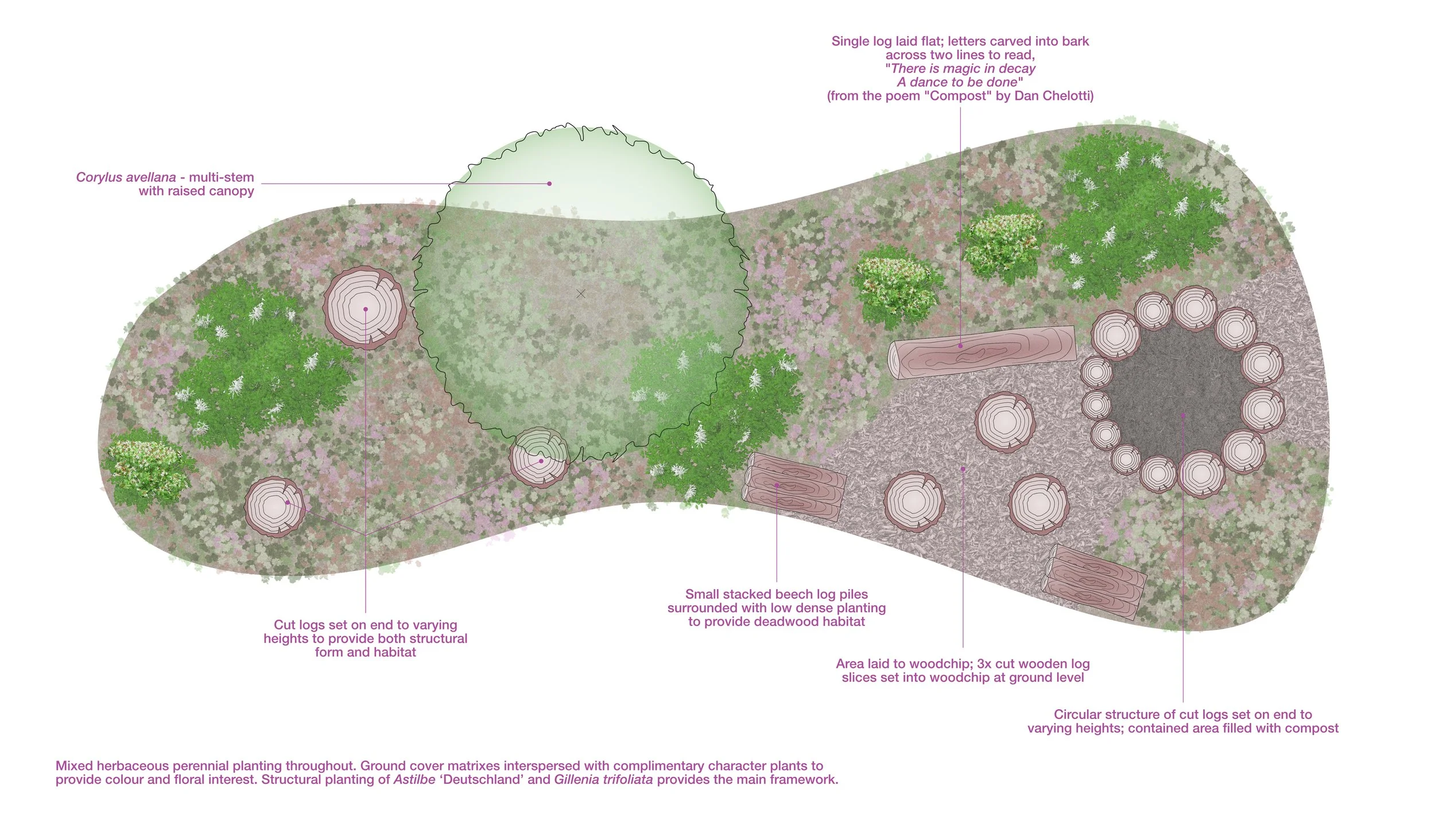
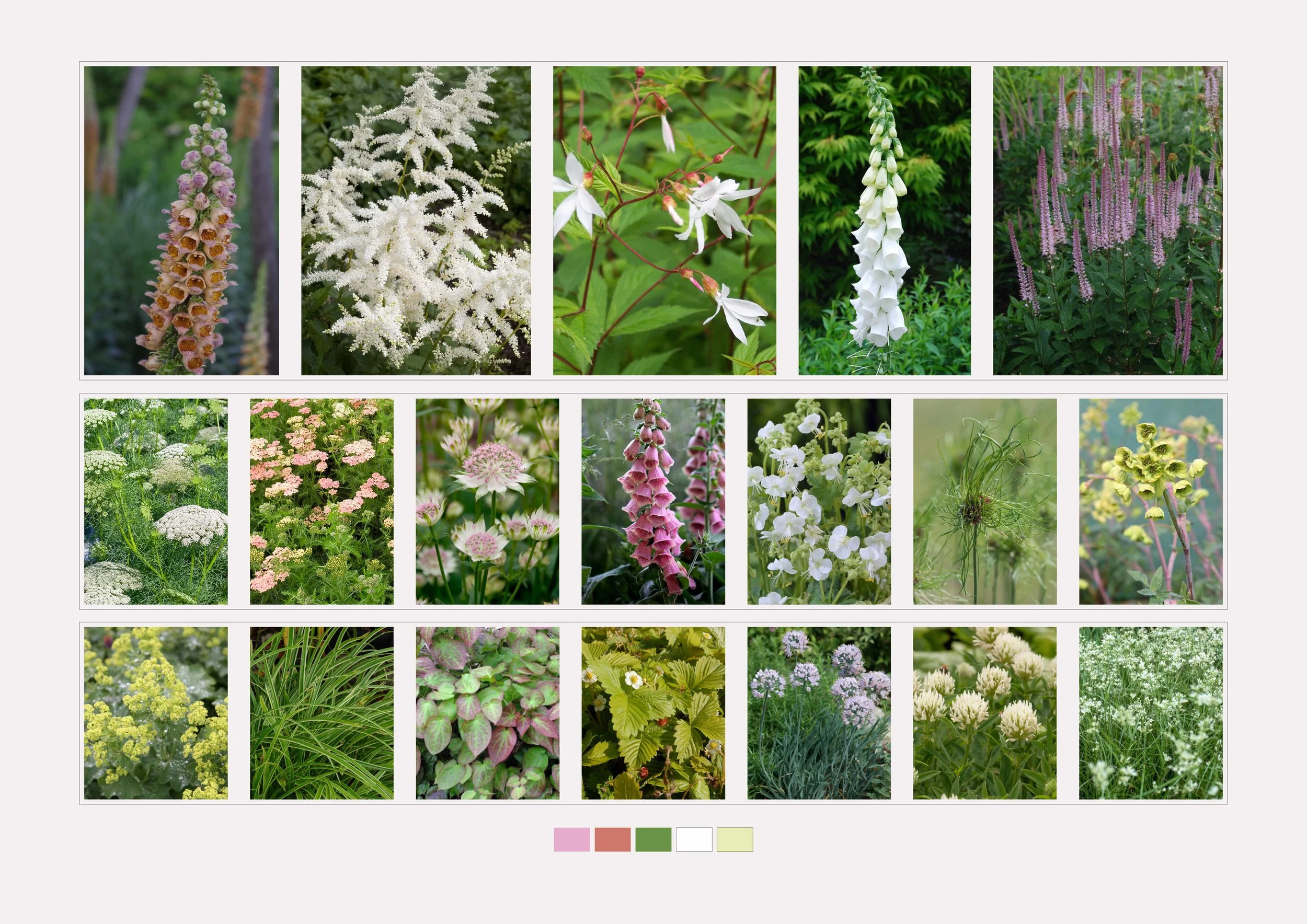
The planting adopts a naturalistic approach, using predominantly herbaceous perennials. The colour scheme includes faded pinks, reds and copper tones to reflect gradual decay, whilst fresher whites, pinks and greens provide the theme of emerging life and fertility. Structural anchor plants provide a shrub-like framework amid a low-lying matrix of mixed foliage. A multistem Corylus avellana provides wild yet structural form.
Plants have been specifically chosen to evoke elements of compost. The wispy texture of the flower panicles on Astilbe ‘Deutschland’ are suggestive of the steam that rises from an active living compost heap. And red stems on some of the planting (such as Gillenia trifoliata) represent the composting worm Eisenia fetida.
Plants with upright flower spikes represent the dynamic shift of emergence, celebrating new life from organic waste. Numerous character plants offer varied visual interest and suggest the transition from fertile woodland to open country.
The inspiration for the garden stems from my local community composting scheme BATCOM, of which I am one of the directors. During my involvement I have observed the development of this collective endeavour as both a welcome space and a local community resource. This led me to reflect on parallels within the ecosystem of compost itself, and how decay feeds vitality through community. We can think of community existing across both micro- and macro-levels - from microbial and fungal activity in the composting process, through complex layers of organisms using decaying vegetation for food and shelter, expanding out to schemes that support community between people, promoting human networks.
I am very honoured and excited to have the chance to build this garden at the show, which will be open from Wed 8 - Sun 12 July 2026. Further details here.
Sponsored by Treasure Gardening
Treasure Gardening produce a premium, peat-free compost called Wonderfuel. Crafted over eight years by leading horticultural experts, Wonderfuel comes in a two-stage blend: Stage One is a compost mix for seeds, cuttings and houseplants; Stage Two is designed for growing plants in pots and containers.
Save 20% on purchases of Wonderfuel as a special show promotion.
Visit www.treasuregardening.co.uk and use the code BADMINTON26
Plant List
Achillea ‘Lachsschönheit’
Alchemilla mollis
Allium senescens
Astilbe ‘Deutschland’
Astrantia 'Buckland'
Carex ‘Ice Dance’
Cenolophium denudatum
Corylus avellana
Deschampsia cespitosa 'Goldschleier'
Digitalis × valinii 'Falcon Fire' [Digiplexis 'Falcon Fire']
Digitalis × valinii 'Firecracker' [Digiplexis 'Firecracker']
Digitalis x mertonensis
Epimedium x rubrum
Filipendula ulmaria ‘Rosea’
Fragaria vesca 'Alexandra'
Geranium macrorrhizum ‘Geronimo White’
Luzula Nivea
Lysimachia barystachys ‘Huntingbrook’
Mathiasella bupleuroides ‘Green Dream’
Penstemon digitalis 'Husker Red'
Sorbaria sorbifolia 'Sem'
Thalictrum 'Splendide White'
Trifolium ochroleucon
Composting
A selection of useful resources
Garden Organic have a great webpage on composting that includes videos and FAQs. They also run the Master Composter programme - a team of volunteers who spend time promoting home composting in their local community
Charles Dowding provides a wealth advice on making and using compost as part of his online No Dig Resources. I'd also recommend his book, Compost – Transform Waste into New Life
Gloucestershire Recycles has a webpage that covers plenty of topics to do with home and community composting, plus they offer a free self-led online course to help you find out more
Get Composting work in partnership with UK local authorities to provide discounts on compost bins and water butts. It is well worth checking whether your local authority provide this service
Carry on Composting provides a lot of useful information about home, allotment and community composting, including pages dedicated to starting a community compost site
Devon Community Composting Networkhas been involved in looking at community composting for many years. They have a lot of information about this on their website, as well as general information about all things compost
Agriton Group have a blog page (posted Jan 2026) that pulls together information from various sources in order to clarify the rules around community composting
Enrich the Earth is a collaborative partnership bringing together diverse organisations committed to sharing knowledge, ideas, and resources to support the transition away from peat use in horticulture
Inspirational community composters
There are plenty of inspirational people working in all areas of the UK, offering different working models of community composting schemes. Here are just a few of them:
Bisley Community Composting Scheme is the longest running community composting scheme in Gloucestershire and a great inspiration to anyone considering community composting in their own region
Brimscombe & Thrupp Community Composters (BATCOM) is a scheme close to my heart! A community-owned and volunteer-run scheme based near Stroud
Brighton & Hove Food Partnership, supported by Brighton & Hove City Council, have established a network of community composting sites across the city for food waste
Compost Works is a Liverpool-based social enterprise. They set up communal composting facilities across Liverpool City Region to convert local food waste into compost
Proper Job is an environmental charity and community business in Devon that was developed out of the first community composting project in the county. The project now does far more than just composting! It includes a community shop and café, a resource centre offering workshops and community events, reclamation and furniture schemes, and much more. Its really inspiring to see how they have developed and diversified in order to tackle waste reduction and sustainability on many fronts